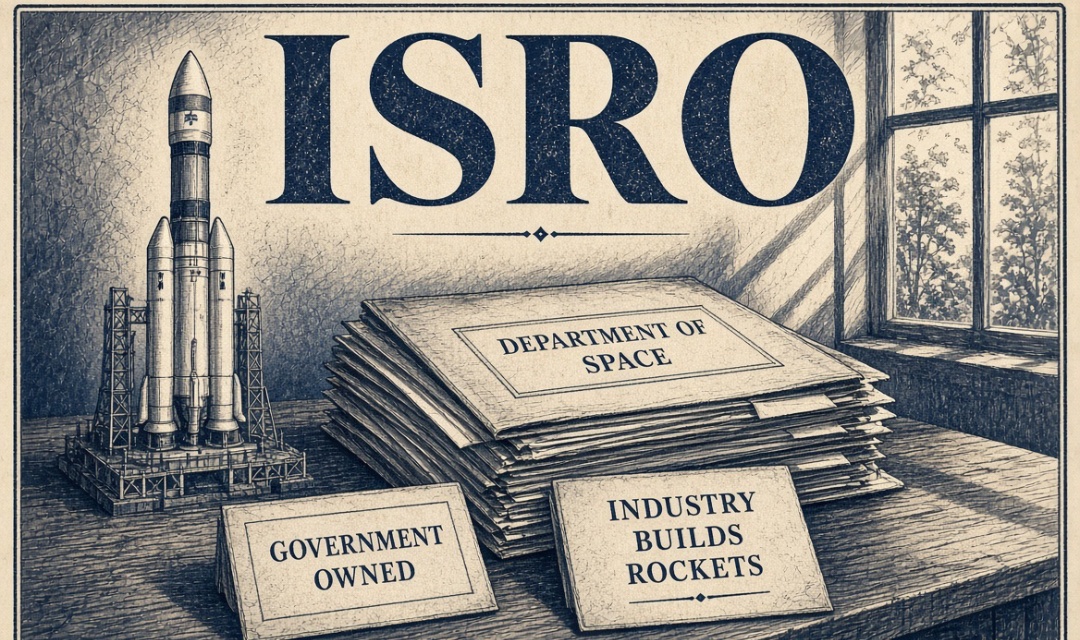
Claim: The government is privatising ISRO — transferring the space agency, or its manufacturing and operations, to private companies.
Verdict: False
On the record: ISRO, 6 September 2026: “ISRO will neither be privatised nor will its importance be diminished.” Chairman V. Narayanan repeated that line on 7 September. No Cabinet or Department of Space order transfers ownership of the agency.
By Raushan Kumar, Founder & Editor. Verified against the 6 September ISRO note, Narayanan’s 7 September remarks, Goenka’s 21 August summit line and his 6–7 September follow-ups, and the Indian Space Policy 2023 split of work. Method: Editorial Standards.
New Delhi / Bengaluru — 8 September 2026. Last updated 8 September 2026.
The spark is a sentence from 21 August. At Business Today’s India @ 100 Economy Summit, IN-SPACe chairman Pawan Goenka said, as India Today and later Hindustan Times recorded it:
ISRO will not make any launch vehicles and will not manufacture any launch vehicles. That will all be done by the private sector or PSU.
Nine staff associations wrote to ISRO chairman V. Narayanan on 4 September and asked whether that line was official policy — and what it meant for people already on the rolls. Media copy sitting on top of the letter treated a larger private role as a sale of the agency. By Sunday night the space department’s own accounts were answering the second claim, not the first worry.
The claim under review is the sale. A forwarded government line going around as a finished decision is the same pattern we checked on the PM-KISAN Rakhi ₹4,000 clip.
What ISRO put on the record on 6 September
The agency posted a note titled “ISRO’s Next Chapter: Leading India’s National Space Ecosystem.” The Week and Outlook quote the same sentences that sat on @isro that evening.
There has been considerable reporting in parts of the media around the future role of ISRO including speculations and misinformation that there is an attempt to privatise ISRO or reduce its role. These assertions are completely baseless and incorrect.
We wish to categorically state that ISRO will neither be privatised nor will its importance be diminished.
The same note says ISRO remains the principal government body for advanced research, national and strategic missions, space science, and frontier capabilities. Private firms, start-ups and campuses are being asked to take a larger share of work that is already mature — building more of the same rockets and satellites — so the lab can spend people on the next machines. “What is changing is not the importance of ISRO, but the scale and structure of India’s space ecosystem,” the note says.
What the chairman said the next day
Narayanan spoke on the sidelines of the Bengaluru Space Expo on 7 September. India Today recorded the short version: “ISRO is not privatised.” He put the 2020 reform in one sentence — the department was told to handhold private industry and grow the ecosystem — and then named the capacity problem. The country, he said, needs around 50 launch vehicles a year. Hundreds of Indian firms already feed the existing launch line. Volume at that scale is not a one-lab job.
Staff had asked for a written Department of Space reply. Narayanan declined to issue a letter because one or two groups had written in. He said ISRO has about 20,000 employees and that those employees would be addressed. That is a labour-relations answer. It is not a gazette transferring the agency.
IN-SPACe and NSIL are the other two names in the file
Goenka chairs IN-SPACe — the Indian National Space Promotion and Authorisation Centre, the office that licenses non-government players. On 6 September he posted on X, as carried by Business Today and ANI:
There has been some misleading narrative in the media around the future role of ISRO. Let me say it unequivocally: ISRO’s role is by no means diminishing. It will remain the bedrock of Indian space sector.
He named the 2020 split of work. IN-SPACe authorises private and other non-government activity. NewSpace India Limited (NSIL), the commercial arm, sells capabilities that are already proven. Goenka listed the missions that stay on ISRO’s books: a Bharatiya Antariksh Station by 2035, a crewed Indian Moon flight by 2040, next-generation launchers, and ongoing lunar and planetary work.
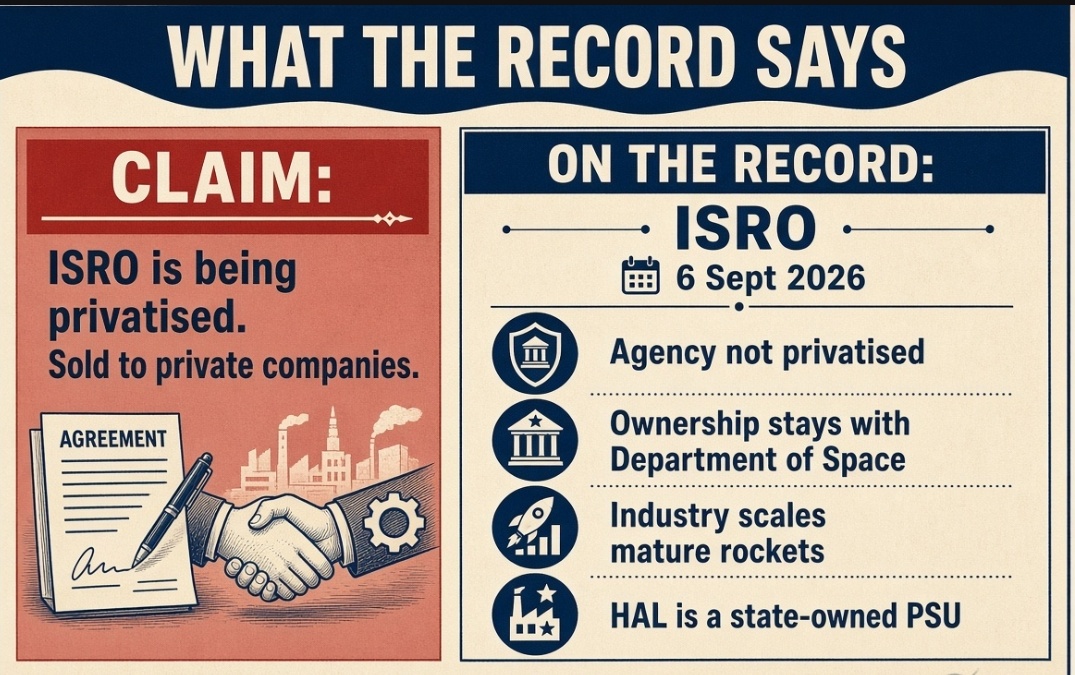
On 7 September he also narrowed the 21 August line. CNBC-TV18 recorded him saying human-rated and strategic launch vehicles, and new systems such as the reusable launch vehicle, stay with ISRO; private manufacture of a PSLV-class rocket would take years and only after the receiving firm is technically qualified. SSLV production rights have already gone to Hindustan Aeronautics Limited, a state-owned aerospace PSU, after a bid. That is a transfer of a mature product line to another government-owned company. It is not a transfer of the organisation.
The Indian Space Policy 2023, issued by the Department of Space, is the public rulebook for who may build, launch and operate. A policy that lets industry scale a mature rocket is a procurement and licensing change. Privatisation, in the ordinary sense, is a transfer of ownership of the organisation. No release this week announces that transfer.
Swipe sideways on a phone. First row is the claim under review.
Staff concerns about future recruitment and which factory floor they report to are live labour questions. They do not convert a 2020–2023 policy, or one summit sentence about mature rockets, into a sale of ISRO. Read the 6 September ISRO note and Narayanan’s 7 September line before forwarding the privatisation clip.
Corrections: corrections@thefactsdesk.com. The change will be noted on this page.
Editorial Sources
- India Today, 21 Aug 2026 — Goenka summit line on launch-vehicle manufacture
- Hindustan Times, 7 Sept 2026 — staff letter tied to that remark
- ISRO on X — 6 Sept 2026 note
- The Week, 7 Sept 2026 — ISRO rejection
- Outlook, 7 Sept 2026 — agency and Goenka
- India Today, 7 Sept 2026 — Narayanan: “ISRO is not privatised”
- Business Today, 6 Sept 2026 — Goenka X post
- ANI, 6 Sept 2026 — Goenka wire
- CNBC-TV18, 7 Sept 2026 — carve-outs and HAL/SSLV
- The Facts Desk — PM-KISAN Rakhi claim