Claim: One Nation, One Election has been finalized and locked for the 2029 Lok Sabha elections.
Verdict: Missing Context / Unverified
Fact: The 129th Constitutional Amendment Bill is pending before a Joint Parliamentary Committee. Under proposed Article 82A, the appointed date begins only after a general election, so the first full synchronized cycle under the current draft would target 2034, not 2029. A separate NDA talk about dissolving willing state Assemblies for 2029 remains exploratory.
New Delhi — 25 August 2026. Last updated 25 August 2026.
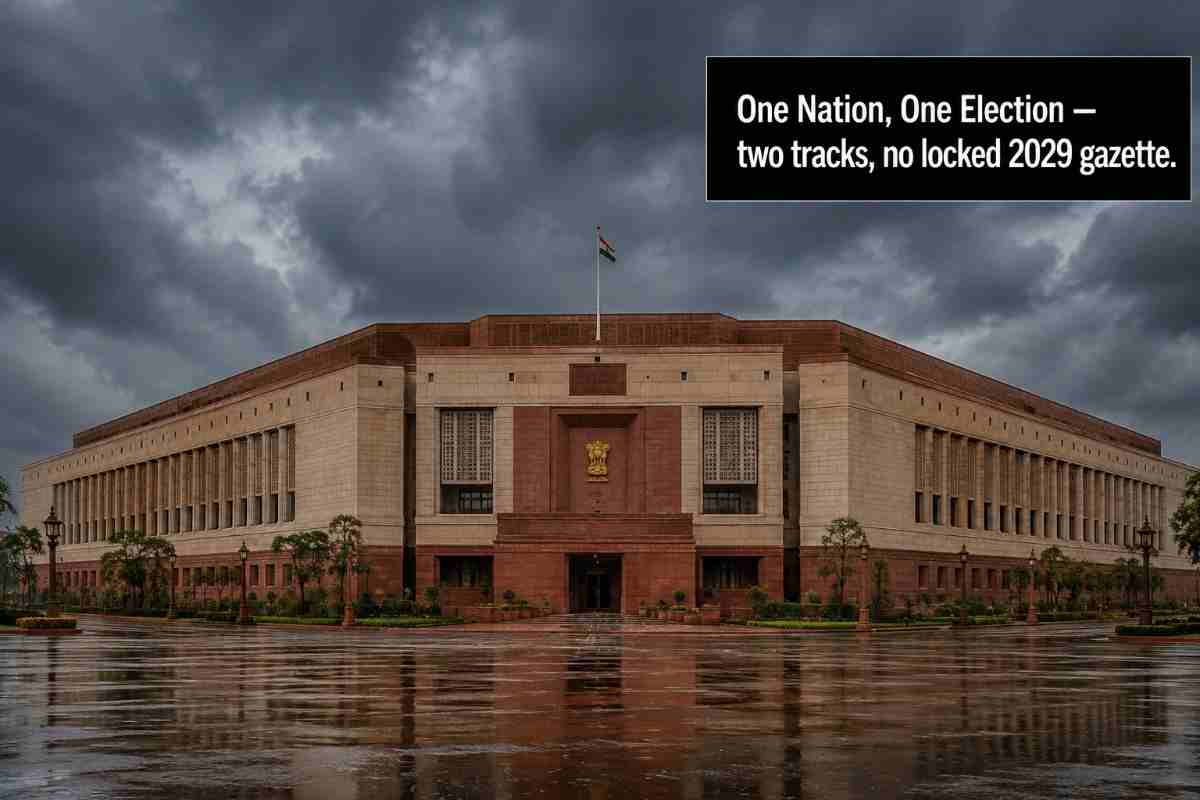
The clip making the rounds this week shows a tick mark stamped over a photo of the Lok Sabha, captioned “2029 — Locked.” Treating that stamp as a finished law means treating a Bill that still sits in committee as if the Election Commission had already named the year.
The legislative text of the Constitution (One Hundred and Twenty-Ninth Amendment) Bill, 2024 introduces Article 82A and sets specific statutory triggers. The President may issue a public notification “on the date of the first sitting of the House of the People after a general election.” The Bill calls that notification the appointed date. Simultaneous polls, under clause (3), are then to be held before that House finishes its full term. Read those two sentences on a calendar and 2029 is the election after which the clock would start — not the year the first joint cycle would land.
Viral posts skip that arithmetic. They also skip a second file that landed two days before this dateline: an NDA discussion about dissolving Assemblies in the 22 states and Union Territories it currently governs, so those houses could vote with the Lok Sabha in 2029. That discussion is real. It has not been notified, and it is a different legal tool from Article 82A.
What JPC Chief P.P. Chaudhary Actually Said About 2029
At the Parliament House complex on 24 August, reporters asked whether State Assemblies could vote with the Lok Sabha in 2029. Chaudhary, a BJP MP from Rajasthan who chairs the Joint Parliamentary Committee, did not announce a sealed date. He said a rollout can begin in 2028 if Parliament approves the amendment by then, and that Delhi cannot order a State to dissolve its Assembly. If a State Council of Ministers wants its poll held with the Lok Sabha, “then it is possible. It is up to them what they decide.” The Hindu report of 24 August is the record of that exchange.
The same chair has said 2034 is the earliest full cycle under the Bills as they stand. In June 2025 he told The Indian Express that the earliest simultaneous elections can be held under the existing Bills is 2034. In March 2026 he told The New Indian Express that once the amendment is passed and notified, “the earliest feasible cycle for implementing ONOE would be 2034.”
Those two numbers stop looking like a U-turn once you split the files. The 2034 date is the statutory clock in Article 82A. The 2029 talk, which Chaudhary put back on the table this week, is about something else: willing state governments cutting their own terms.
The NDA’s 22-state discussion is a second track
On 23 August, The Indian Express reported that the NDA is exploring whether Assemblies in the 22 states and Union Territories it governs could vote with the 2029 Lok Sabha, instead of waiting for the 2034 cycle the Bills describe. Business Today and Outlook carried the same reporting the same day. A source familiar with the talks said 11 of those 22 houses are already due before 2029; four — Andhra Pradesh, Arunachal Pradesh, Sikkim and Odisha — already run with the Lok Sabha. The rest would need early dissolution. Article 174(2)(b) lets a Governor dissolve an Assembly, usually on the advice of the Council of Ministers. That does not start a statutory six-month clock. In In Re Special Reference No. 1 of 2002, the Supreme Court held that neither the Constitution nor the Representation of the People Act, 1951, prescribes a time limit for a poll after an Assembly is dissolved; Article 174(1)’s six-month rule applies to a sitting House. In practice, elections have usually followed within about six months.
When Express asked Chaudhary whether simultaneous elections could be held earlier than the Bills provide, he said: “It is for the NDA Chief Ministers to decide. This issue is outside the mandate of the committee.” After meeting the JPC, the Chief Ministers of Goa, Uttarakhand, Haryana and Delhi had already spoken in favour of simultaneous polls. Houses the NDA does not run are outside that conversation. Article 82A is unchanged by it.
Conflating the two tracks is how the tick-mark clip gets made. A party asking its own Chief Ministers whether they will cut terms is a political plan. A constitutional amendment that has not passed is a legal plan. The clip sells both as a locked national calendar.
Chidambaram’s JPC Deposition vs. Public Critique of Article 82A
On 24 August, former Union finance minister P. Chidambaram deposed before the same JPC. Coverage of that sitting — including The Hindu — reports he called the Bills monstrous, mindless and unconstitutional. The closed-door evidence stays with the panel; those three words are what reached print.
On 25 August he went public with the thrust, not the transcript, on X (@PChidambaram_IN). ANI carried the post the same morning. He wrote that he was not at liberty to disclose his evidence, but that the basic thrust was that the Bill violated the basic features of the Constitution, “especially the tenets of parliamentary democracy in a federal country.” He had read the chair’s reported claim that simultaneous elections are possible in 2029. “I am afraid his view is wrong and goes against the text of the Bill.” Then the mechanism: even if the Bill is passed, “the ‘appointed date’ under the Bill can only be a date ‘after a general election’. The next general election will take place in 2029. Hence, simultaneous elections are not possible in 2029, which is a blessing.”
The deposition made the constitutional argument behind closed doors; the X post made the arithmetic public. That post is about the 82A track. The Article 174 discussion was not before the JPC.
How Article 82A Sets the Clock — and Why 2034 Follows 2029
Clause (1) of the Bill PDF lets the President notify on the first sitting of the Lok Sabha after a general election; that notification is the appointed date. Clause (3) then directs the Election Commission to hold simultaneous elections before that House’s full term expires. The next general election is due in 2029, so the first joint cycle on this wording falls around 2034.
On a phone, swipe the table sideways to read all four columns.
This reading aligns with PRS Legislative Research, which works an example under “Term of Legislatures”: “suppose the President notifies the adoption of simultaneous elections in June 2029, so that the first such election may be held around June 2034.” PRS’s own briefing runs the same math. Parliament could still rewrite the clause, and States could still volunteer to cut terms.
Current Legislative Status: Where the 129th Amendment Bill Stands
Law minister Arjun Ram Meghwal introduced the 129th Amendment, with a companion Union Territories bill, in the Lok Sabha on 17 December 2024. PRS records the JPC referral as 19 December 2024. The Bills have not been passed. There is no Gazette bringing Article 82A into force, and no Election Commission press note naming 2029 as a simultaneous-poll year. On 7 February 2026 Meghwal posted from @arjunrammeghwal after a Delhi conference, arguing for a stronger, cheaper process.
The JPC remains the next gate. On 29 July 2026 the Lok Sabha extended the panel to the last week of the Winter Session; All India Radio reported it. In May, PIB quoted Chaudhary saying the reform “must be implemented” and that the committee wanted a law “acceptable to everyone.” In September 2023 a Kovind committee had recommended the shift; Cabinet accepted that report in 2024, per a PIB note.
Why this matters
If 2029 is treated as decided, two files get sold as one. The Bill has been introduced and referred, and has neither passed Parliament nor been scheduled by the Election Commission. The Article 174 conversation still hangs on Chief Ministers who have not dissolved a house. Mix them and a tick mark looks like a Gazette.
Key timeline
- 17 Dec 2024 — 129th Amendment introduced by Arjun Ram Meghwal; PRS records JPC referral on 19 Dec.
- 10 Jun 2025 — Chaudhary, to The Indian Express: earliest simultaneous polls under existing Bills is 2034.
- 23 Mar 2026 — Chaudhary, to The New Indian Express: earliest feasible ONOE cycle would be 2034.
- 29 Jul 2026 — Lok Sabha extends JPC tenure to the Winter Session.
- 23 Aug 2026 — Indian Express: NDA exploring 2029 joint polls in 22 states/UTs it governs; Chaudhary: CMs to decide, outside JPC mandate.
- 24 Aug 2026 — Chaudhary: 2029 possible if amendment by 2028 and States agree. Chidambaram deposes: Bills unconstitutional.
- 25 Aug 2026 — Chidambaram on X: chair’s 2029 reading “goes against the text of the Bill.”
Fact-check verification
Held by the record
- The 129th Amendment Bill exists, inserts Article 82A, and sits in a JPC. PRS lists it as not passed. Its appointed-date math, including PRS’s June 2029 → June 2034 example, points at 2034 for the first full cycle.
- Chaudhary on 24 August 2026 tied any 2029 alignment to an amendment by 2028 and to State willingness. On 23 August he told The Indian Express that going earlier than the Bills is “for the NDA Chief Ministers to decide” and “outside the mandate of the committee.”
- Chidambaram’s 25 August post argues the 82A track: appointed date only after a general election, next one in 2029.
Not held
- That One Nation, One Election is locked for 2029. No gazette, no ECI notification, no all-State consent.
- That an NDA discussion about dissolving 22 Assemblies equals a nationwide simultaneous poll in 2029.
Still open
- Whether the JPC reports this Winter Session, both Houses pass the amendment, and whether NDA Chief Ministers actually advise Governors to dissolve houses under Article 174(2)(b).
Is One Nation, One Election locked for 2029? Under the plain text of proposed Article 82A, the synchronization clock only begins after a general election is held. Because the next general election is slated for 2029, the first full synchronized cycle under the current draft would fall at the conclusion of that five-year term in 2034. A second track — NDA states choosing to cut their own terms — is being talked about. It has not been notified. The Bill PDF, the 23 August Express report, and Chidambaram’s 25 August post are the texts to read before the tick-mark graphic.
Corrections: if the date or the clause is wrong, write contacts@thefactsdesk.com. The change will be noted on this page.