Claim: Yash’s Toxic is a true historical account of Portuguese-era Goa — a real colonial crime chronicle, not invented drama.
Verdict: Misleading (fictional plot / historical setting)
Fact: Portuguese rule in Goa lasted until Operation Vijay on 18–19 December 1961, fourteen years after Indian independence. The film is a written gangster story set against that backdrop. Treating Raya as a real figure, the cartel as a real file, or the plot as a documented chronicle overstates what the makers — and the 1961 record — actually support.
New Delhi / Panaji — 26 August 2026. Last updated 26 August 2026.
Years: real. Cartel and Raya: written. Portuguese-era Goa is the backdrop. It is not a true-story stamp.
Even the film’s own marketing and its own star put the story in different years. At CinemaCon 2026 Yash put the window at 1947 to 1961. The studio’s February synopsis — the one a UAE distributor circulated, which The Indian Express and Hindustan Times both printed — said “Set in Goa between the early 1940s and the 1970s,” in “fading colonial shadows.” That’s a wider range than Yash’s own quote — covering the plot’s full span, not asserting Portugal still governed Goa in 1970.
A story that starts under the colony and runs a decade after Liberation Day is an ordinary period-drama shape. “Fading colonial shadows” is the phrase that already does that work.
Rotten Tomatoes now carries a tighter official logline: “Independence has swept across India, but Goa still answers to the Portuguese,” set in “the uneasy years before liberation.” So the studio itself has used two clocks — both marketing copy, neither a document you’d find in a Gazette.
What went viral on top of that
On 14 February, Instagram account @screenplay.memes recapped the colonial setting correctly, then added: “Industry buzz indicates the film could explore a shadowy Indo-Portuguese drug cartel that allegedly operated during the politically volatile transition period. If true, this would place the narrative in a historically sensitive and layered setting.” “Allegedly” and “if true” present a rumour as if a cartel file already existed. No such file is cited.
By July a fan clip on X, @beingsumit01 (“Yash Just Revealed What Toxic Is Really About”), had passed 1,800 likes and about 196,000 views by packing ports, Tommy guns and a father-son revenge saga as the hidden truth of the movie. On release day, 26 August 2026, that mix — real colony, invented cartel — is easy to take for a reconstructed case file.
What Yash and Geetu Mohandas put on the record
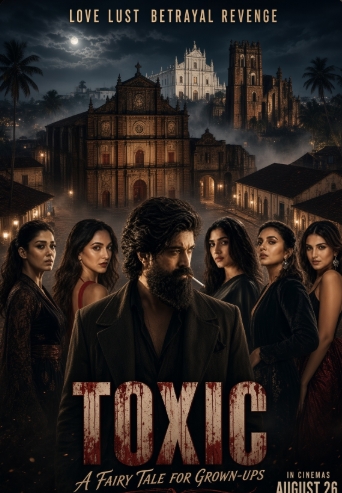
Geetu Mohandas directed Toxic: A Fairy Tale for Grown-Ups. Yash plays Raya. When the CBFC issued an A certificate, The Indian Express printed the logline: “A gangster navigates the complexities of loyalty, morality, and the struggle for personal redemption in a post-independence Goa where violence and jealousy reign.” That is a setting, not a citation.
At CinemaCon, The Times of India recorded Yash on the dates: “It’s set in an era where in 1947 India got independence, but a small state like Goa was still under the Portuguese till 1961.” He talked about the port, gangsters and smuggling. In the same interview he added the line the true-story posts skip:
“It’s a fictional story — that’s why it’s called ‘Toxic: A Fairytale for Grown-Ups.’”
A Pinkvilla write-up from the same event has a matching line: a father-and-son revenge saga that “begins after India gained independence and the British had left, while Goa was still under Portuguese control.” The Hindu’s coverage of the 8 August trailer launch stops at Yash backing the film.
Portuguese-era Goa on the official record
British India’s August 1947 transfer left Goa out — it stayed Portuguese India, Estado da Índia, alongside Daman and Diu, a holdover from Afonso de Albuquerque’s 1510 capture. On 18 December 1961 the Indian Armed Forces launched Operation Vijay. The Portuguese governor-general surrendered on 19 December, which New Delhi marks as Goa Liberation Day. A PIB note on the 2021 ceremonies says the day marks “the success of ‘Operation Vijay’ undertaken by the Indian Armed Forces.” A later PIB release dates the launch of that operation to 18 December 1961.
Yash’s 1947-to-1961 span matches that calendar, with one slip of vocabulary. Yash’s phrasing calls Goa “a small state” in those years; the accurate term is Union Territory from 1962, state only from 1987. A 1940s–1970s span just means the plot keeps running past Liberation Day — “fading colonial shadows” already covers that, no extra years of Portuguese rule required.
Raya is a written character. The CinemaCon answer already treated the plot as invented.
Why this matters
People who treat the Instagram cartel line as reporting will walk into a Geetu Mohandas gangster film expecting a reconstructed smuggling case, or a liberation chronicle. People who treat 1961 as optional costume will miss that Operation Vijay is a dated military action on the PIB calendar. The film can use Portuguese-era Goa as backdrop while the studio’s own two clocks — 1947–61 versus 1940s–70s — stay what they are: a marketing mismatch. For more on how this desk splits a claim from a calendar, see The Facts Desk.
Swipe sideways on a phone to read all three columns.
Is Yash’s Toxic based on Portuguese-era Goa? The years match the official calendar. The people and the cartel do not. Yash’s CinemaCon interview already contained that distinction; the posts that travelled farthest did not.
Corrections: if a date, a post, or a quoted line is wrong, write editor@thefactsdesk.com. The change will be noted on this page.